Last week's game against Iowa was the most promising one on Northwestern's remaining schedule not because the 'Cats had any better chance to win than any of their other games but because of the hope that Iowa's offense, which had spent most of the season moving with the efficiency of a person drowning in quicksand, would combine with Northwestern's own struggling unit in a display of football so hideous and offputting that Pat Fitzgerald and all of the available Ferentz in North America would be hauled in front of a congressional panel so that they could be berated by bipartisan lawmakers showing blown up pictures of holding penalties while demanding that they answer to the American people. Alas, that did not happen. Northwestern just got smoked again in a normal bad game.

The Wildcats, with a single win that happened what feels like twelve years ago and absolutely no reason to believe they'll add a second to the tally, are on their way to their worst season since 1989. That year they lost every single game they played. They lost to a then-independent Rutgers. Every game was a double-digit blowout, except the game to Minnesota, which they somehow lost 20-18, a score that to me does not seem possible in 1989. This is not the 1980s, though. Northwestern and its donors have inexplicably poured hundreds of millions of dollars into athletics including a fancy training center, a renovated basketball/volleyball arena, and a proposed new stadium that will cost nearly a billion dollars in its own right, they are paying Pat Fitzgerald a mysterious but presumably hefty salary, and they are getting the same results that they did when the facilities were a strip of grass and a port-a-potty. To be honest this is objectively funny.
To be honest I have not seen a single second of the Iowa game. I was unable to watch the game live and when I saw that the score featured actual numbers and not the primal scream of an undead language, I had absolutely no incentive to watch the specific ways that they had gotten bludgeoned and pinioned all over Kinnick Stadium. Northwestern under Fitzgerald has rarely been a fun team to watch; the entire enterprise, even at its best, often involved grimly clinging to the lead in the second half in a way that resembled watching the second half of Uncut Gems every Saturday.
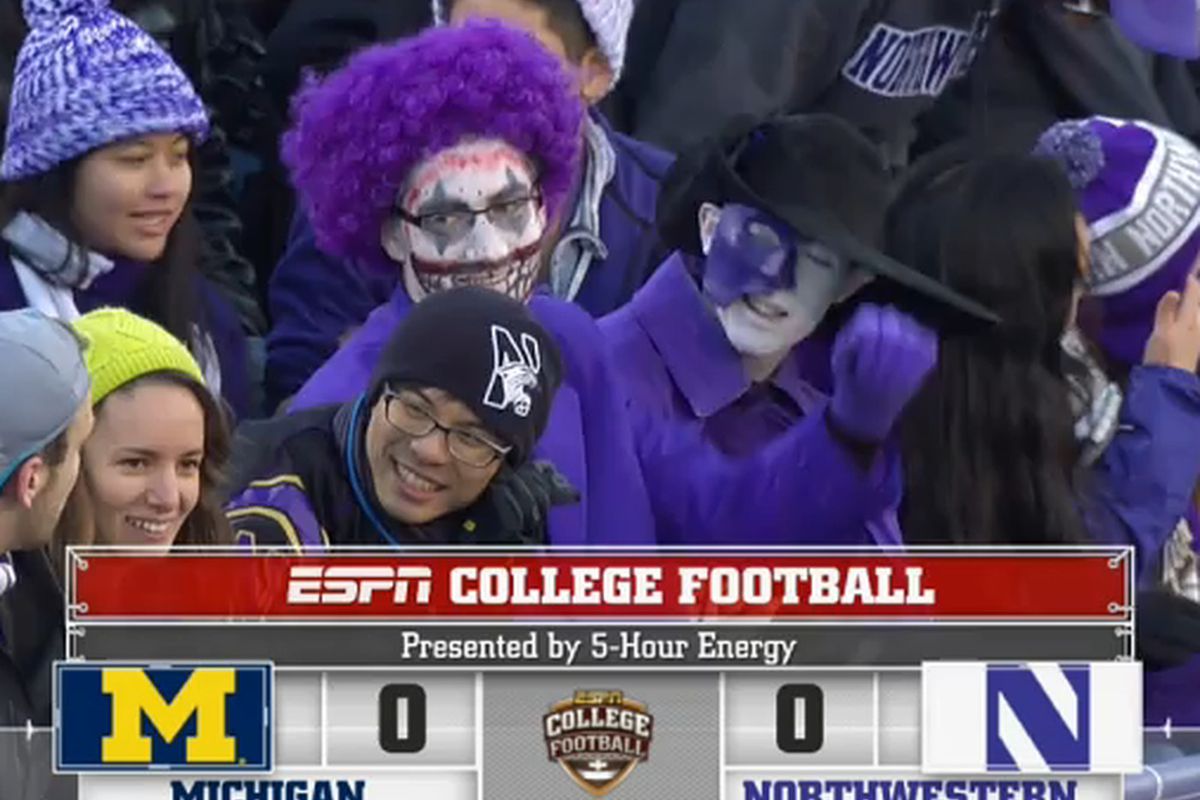
This is how I win
Now, Fitzgerald has the Wildcats play the same style of grimy, grinding football, and the results for the past two seasons have not been there. The faint hope of infuriating or at the very least annoying the various teams of the Big Ten has been evaporating.
The Big Ten West this year is a shit show, a maddening collection of mediocrity. This is the type of year where Northwestern has in the past been able to wriggle through the abyss and end up in Indianapolis or at the very least the Eccentric Uncle Mustache Pincher Wax Bowl. Instead, they just keep getting bonked about the helmet. It is normally hard to make the case to anyone why they should watch Northwestern football or that Northwestern has a football team with uniforms and everything; it is impossible to do so now. Time to look at this week's opponent.
A TECHNICAL AND DETAILED ANALYSIS OF NORTHWESTERN'S UPCOMING GAME AGAINST THE OHIO STATE BUCKEYES

THE WORLD SERIES IS AN INSTRUMENT OF MADNESS
Every baseball fan wants to see their team in the World Series, but it is no small comfort that when that doesn't happen the fan is rewarded with the immense luxury of not having to watch her team play in the World Series. Neutral fans get to enjoy the unbearable tension of each pitch, the crowd roaring and retreating like an ocean wave, the catharsis of a timely hit and the crushing misery of an error and the fans of the two teams playing experience the world series by thinking to themselves: aaaaaahhhhhhhhhh aaaaaahhhhh.
Every big game in a sport offers tension and drama, but baseball's pace is best suited to emotional torture. It's already a slow game, but in the playoffs become glacial. No other sport forces spectators to indulge the players in so much housekeeping. In between each pitch they kick the dirt around, they adjust their gloves and their crotch protecting equipment, they blink and make those weird open-mouthed guppy faces that Dustin Pedroia used to do. The pitchers stare off meaningfully into the middle distance. Every pitch for both teams could mean certain doom.

Baseball excels at doing this to people for four entire hours
Baseball's general slow and ambient nature-- the game is best enjoyed as a soothing background to something else going on during the summer-- gets weaponized into a terrifying dirge in the postseason as the stakes get higher. In its ideal summer form, Ron Coomer is talking about the time he got sandwich poisoning on a road trip in 1988 after eating fourteen chicken parms on a dare from Rick Wrona while you chop onions without a care in the world; October finds you watching Jake Arrieta stare at the catcher with pupils the size of pinpricks for 45 seconds while feeling like you are going to vomit.
But for those of us lucky enough to root for shitty teams, the playoffs offer a delightful voyeur's window into mass nervous breakdowns. Every cut to a fan shows a group of people on the verge of bursting into tears, every home team setback is met with an eerie, miserable silence. Baseball is the only major sport that allows fans space to perceverate and to stew, unbothered by anything happening other than players standing around. Everything about the postseason, from the way that its best teams are promised nothing from a short series to prolonged the way games unfold over a feeling of relentless dread, makes the fans of teams almost rooting for it to end. It is absolutely wonderful to enjoy without caring who wins and utterly unbearable to endure for fans of teams in it, and I desperately hope the Cubs make it back so I can be miserable again.
THE INDIANAPOLIS EXPRESS
Hugh Millhew was not sure why he stopped the bus for the stooped, bearded man or why he decided to change course and ferry him to Indianapolis. He figured he had a bus now, and when he stopped the man tried to get on, and, after thinking about it for a few minutes he could not come up with a good reason not to go to Indianapolis.
Millhew hadn’t planned on driving a bus on this trip or at any point in his life. His problem was that he liked talking to people and, in this case specifically, people in a bar next to his motel. In this case that was M. Powell Straigthurt, the proprietor of Straithurt Motors on Route 19 who pulled up in a glistening Dodge and told Millhew he could have it for his old Buick plus $180. Millhew said he wasn’t a fool, he wanted to have a look at the thing first. He popped the hood right in the parking lot.
“This thing has a worn alternator, the tires are practically bald, and the radio only gets the bad religious station,” Millhew said, trying to be as nonchalant as possible. “Clutch is sticky too.” Millhew also did not have $180 on him either, but he kept that to himself.
“Son, you drive a hard bargain, but I can tell you know your way around an automobile,” Straighthurt said. “I’ll tell you what I’ll do. How about a straight up swap? I could always use another Buick, even if it’s just for parts.”
That irked Millhew. Sure, the Buick needed some work, the fuel pump was nearly shot, and every four or five times it needed a kick in exactly the right place on the front fender in order to fully turn over, but he had kept it running all the way from Lubbock. But he couldn’t pass up a swap.
Straigthurt proposed doing the trade tonight. He said that did not want other customers seeing him give Millhew such a good deal and then demanding a nice Dodge for their own hunks of junk. Millhew was a little dubious, but he also noticed a flushed and swaying demeanor in the man and figured the rum cocktails he had seen Straighthurt downing one after the other could be playing a role here and it might be best to act before the man sobered up.
Millhew could tell Straighurt Motors was a major operation based on the billboard he saw with the M. Powell’s grinning face looking like the face of the moon and the fact that roof had an enormous inflatable gorilla ("Get yourself a deal that's INSANE!!!" the sign said, making the gorilla's presence somewhat of an enigma). Straighhurt took him to the business office in a trailer in the back of the lot. Millhew sat filling out dozens of forms. It seemed like every for paper he filled out, Straighthurt produced two more and as he attacked them, Straighthurt pounded addenda and clauses out on his typewriter, squinting through half-glasses. Finally he finished. Straighthurts produced a bottle of something brown and offered it to Millhew, but Millhew did not feel like celebrating.
“If it’s all the same to you, Mr. Straighthurt, I’d just like the Dodge and I’ll be on my way.”
“Well, I’ll be,” Straighthurt said. “We have a bit of a complication. You see, the Dodge, I just saw it is not available. Already sold to Mr. Lardner N. Wiltnoy. Taking delivery on the 24th. What a horrible oversight. My deepest apologies.”
“OK then, I’ll just take the Buick back,” Millhew said
“Well, I'm afraid I can’t do that. You see, you’ve just signed it over to Straighthurt Motors. Here it is, in triplicate. Why, I just saw you fill out the forms yourself.”
Millhew was furious. He cursed. He whirled around to get the police. But then he saw it: a whole wall of photos of Straighthurt grinning that billboard grin of his with every badge in the county. There was one with him and the police department softball team he sponsored. There was one directly behind his head with the sheriff. He was smiling the same smile as in the picture now.
“You’re welcome to talk to Sheriff Maughton. I’m sure he would be happy to take a look at the paperwork we’ve established here,” Straighthurt said. “Of course, I would never just take a car from someone like you. That would be fraudulent and you don’t get to be the sponsor of the sheriff’s bowling team with those sorts of lax attitudes towards the law and the constitution. I can’t get you the Dodge, but I’ve got just the vehicle for a youngster who knows his way around an engine block.”
Millhew had no choice and he followed him to the back of the lot. That’s where it was: an ancient, rusted bus. It still had “Billy’s Big Billy Boy’s Band, Brownsville” stenciled on the back. It smelled like it was leaking oil like a gutshot gunfighter.
“Look at this fine automobile. Been all over the country, all over the hemisphere. Still runs like a dream. Seems perfect for an itinerant man such as yourself in his journeys. Maybe meet a nice girl. Maybe meet a few nice girls. You’ve got the room in here.”
Millhew didn’t want the bus. But he also didn’t want to walk out of there and those were his only choices. He also noticed that Straighthurt had his hand grasping something in his pocket. He sighed and took the keys and the registration.
The plan had been to take the interstate out east and track down his friend Frad Croddle, but Frad had stopped answering the phone and the one time he tried to take the bus on the interstate it had moved so ponderously that multiple drivers threw hamburgers at him and he needed to stop and clean off the windshield. Millhew began meandering through backroads. That’s where he met Professor Huddry.
Millhew had noticed him at the Tri Booth Inn. An old man bearded man in a rumpled suit with threadbare elbow patches was hunched over a table sniffing the fumes from what looked like a cup of tea or whatever spices they managed to dump in a mug full of hot water for him. The old man was surrounded by decrepit cardboard boxes. The man looked at Millhew and introduced himself as Professor Huddry of the Huddry-Mantis Institute, but Millhew simply nodded and went out to the parking lot. He was done with conversations with eccentrics after the Straighthurt fiasco. But when he went to leave, there was Professor Huddry standing in front of the bus’s door like he was getting on the crosstown express.
“I noticed that were driving alone in this great big bus,” the man said.
“I don’t see how that’s any of your business,” said Millhew.
“Well, if you’re heading east, I can use a ride to Indianapolis. My previous travel arrangements fell apart due to a small amount of treachery, leaving me to lug my books and articles and I can't find a single ride that does not appear to be a death trap. This must be the jalopy capital of the United States. I can contribute some gas money.”
Millhew thought about it. He was down to his last $25 or so, and while he had no intention of ever setting foot in Indianapolis, it was at least vaguely in the right direction. Besides, he figured he could kick this odd little man to the curb if he became too tedious. He told him he’d take him up on his offer and began loading the boxes into the bus. There were dozens of them and they had been water damaged by some rain or a puddle and barely held together. It seemed like they had books in them and it took some time to get everything loaded up.
“You don’t know it now, but you’re taking a step to save amateur athletics in this country,” the Huddry said.
"How about we save that first tank of gas,” Millhew said.
The first hours started in silence. Millhew blared the radio (it was the bad religious station, the one with a firebreathing preacher shrieking about his audience going to hell for embracing Satan’s radio) until it faded from the dial and that's when Huddry saw his opportunity to start talking.
“Have you heard of NIL?” the professor said.
“NIL? Is that some sort of chemical?” Millhew replied.
“No, it’s an acronym. That’s when you have letters that stand for words,” the professor said.
“I know that.” Millhew hissed.
“Name, image, likeness. Do you know that that means? Of course you don’t,” Hoddry said. “It means that crime is legal. It means that athletes are for sale. It means that a man’s integrity is on the open market like a hog’s carcass. Name, image, likeness. You’ve got college athletes getting paid now. And it’s all legal.”
Millhew was at a loss. “Why do you care if college athletes get paid?”
“That is just what I expect to hear from a nincompoop. It’s classic nincompoopery. Page 14. Habeas nincompooperus. Do you hear yourself? Do you understand integrity? Amateurism? The ideal of the scholar-athlete? Listen to yourself.”
“You better watch that nincompoop stuff or you can walk. Don’t forget this is my bus.”
“Of course. I apologize,” the professor said. “Not everyone has been exposed to the beauty of pure amateur athletics. You don’t strike me as a collegian.”
In fact Millhew had done one semester at State before both he and the administration came to a mutual understanding that he would no longer burden the faculty with his presence.
“This is exactly the type of situation that Duckett discusses in Chapter 15. I take it you have not heard of Buck Duckett?”
“No,” said Millhew. He pawed at the radio dial.
“Duckett is the foremost mind in amateur athletics. A guardian of sorts. An investigator for the NCAA. I assume you’ve never heard of the Tennessee Pants Bust of 1978. The author of In Cold Pants, a methodological guide to investigating illegal payments but, more than that, a metaphysical journey, a meditation on the soul of amateurism. The most profound sports text that has been written or will be written this century.”
The bus shuddered.
“I hope you don’t expect that I pay for repairs for this wretched wreck,” the professor said.
“The bus is fine. Just needs a little transmission fluid in a few miles,” Millhew said.
“The soul of amateurism,” Hoddry continued. “Do you know that Duckett once broke six ribs impersonating a scout team punter while discovering a ring of Tech players receiving free hoagies every single day from a devious sandwiches magnate?”
“I don’t know, those football players must get pretty hungry running around in the sun all day,” Millhew said.
“Of course they do,” said the professor. “But there are legal sandwiches and illegal– anyway the point seems to elude you. But what I hope is that it won’t elude the National Collegiate Athletics Association. As you can see I’ve prepared several proofs, mathematical proofs based on a numerological reading of In Cold Pants that I have written up so elegantly that it could get through to even the most thickheaded bureaucrat. I believe that once they are confronted with the texts from Duckett, Duckett scholars, and my own work showing that Chapter 13, the one where he details how he rigged up a crude funicular in order to sneak into a fraternity house and reconnoiter a set of golf clubs given to a point guard is actually, when run through a crude but effective cipher, a clear rebuke to the exact NIL code governing the NCAA rules, they will have no choice but to revoke the imbecilic law and stop this monstrous professionalization of football, darts, and croquet.”
Millhew finally managed to find a radio station. It was a small station and it was playing something called the Symphony of Discordant Accordions but he would listen to hours of snoring or shrieking babies to avoid having to endure to more speeches about Buck Duckett and the NCAA. Eventually they decided to stop and get something to eat at a roadside diner. Duckett had hoped to sit alone at the counter but Hoddry motioned him into a booth, and Millhew's manners wouldn't allow him to abandon him.
“The key to understanding Buck Duckett is in line and page numbers, which is why you need the third edition. You see, the key does not work in the first or second editions quite well with the roman numeral introduction and the beastly fourth edition, with an entirely superfluous chapter about the various swashbuckling incidents Duckett endured while investigating fencing teams that was probably ghostwritten by some dullard publisher's assistant.”
A strange man sitting at the counter swiveled around his stool and stared at them. He was as tall as Hoddry was stooped, gangly, clean-shaven, with remarkable ears that drooped down across the length of his tiny face. Millhew was embarrassed because Hoddry was talking his nonsense loudly and occasionally gesturing with a fork. The man got up, seemingly unfolding himself from the stool and materialized next to them with impossibly long strides.
“What’s this Buck Duckett nonsense you’re raving about?” he said.
“Well, this is high-level theory and scholarship. I don’t have time to explain it to another thick-headed oaf. I’m a very busy man with business before the NCAA,” the professor replied.
“Buck Duckett is nonsense. That was debunked years ago. All tall tales from a sad man writing stories about busting water polo players. If you had simply read Pack Bracket, you would have no issues defending amateurism,” the man said.
“Pack Bracket? Pack Bracket? I should have been able to tell I was dealing with a Bracket Man by looking at the ridges on your skull. Look at his head,” Hoddry said turning to Millhew. “The classic shape of a cretin. It is a miracle this man is able to feed himself. Pack Bracket.” Now he looked up at the tall man looming over him. “You realize that it was Bracketism that led right to NIL? The Bracket Men’s texts were so harebrained that the NCAA laughed them out of the room. Or did you not see the issue of ‘Amateur Sports Theorems’ about it? Maybe there weren’t enough pictures.”
“That hearing was a damn stitch-up and you know it,” the tall man said. “The whole thing was already a joke when people started reading this fake detective talking about disguising himself as a waiter to catch Moose Caldwell accepting illegal fireworks when everyone knows Caldwell’s own uncle turned him in.”
“Please,” Hoddry said. “The Moose Caldwell Uncle theory is something I’ve easily debunked if you read chapters four and six of my manuscript. All of the evidence shows that Duckett not only intercepted the pants but also left a series of prophesies embedded by analyzing the sentence structure. But I wouldn’t expect a Bracketist to be able to follow such a basic line.”
“Then you haven’t read Nick Nacket. I have it right here.” The tall man ambled over to the corner of the diner where he had his own mess of cardboard boxes that seemed impossibly damp and began rooting through them.
“Let’s go. We can leave this deluded maniac to his scribblings. We have no time to waste,” the professor said as he gobbled up the remains of his meatloaf and stood up. But he was not fast enough. By the time he finished and paid the bill (the only reason Millhew had not left him at that gas station hours earlier when he got into a thirty minute argument with the attendant about Charleston Chew), the tall man had loped over to the parking lot and was already loading his boxes onto the bus.
“I ain’t letting you go to Indianapolis without at least reading Nick Nacket,” he said, waving a battered volume at the professor.
“Do you think I haven’t read it? Or at least sampled enough of his incoherent nonsense to understand the futility of this enterprise?” By now both men were on the bus pointing their arms at each other and taking turns rifling through boxes to shove documents at each other while invoking the names of Beckett Heck and Truck Van Truk.
Millhew quietly slipped out of the parking lot and onto the road and stuck out his thumb.


