Friday, August 26, 2022

Football on TV

Picture a college football game: it’s a kaleidoscope of light and sound, of organized bellowing, of overwhelmingly blaring music that is one of the three types of music that are allowed to be played at a college football game: popular songs from five year ago, the AC/DC catalog, and martial music from the early 1900s played by students dressed like Habsburg infantry. The stands are full, the stadium quakes, the pads clack under the din, the smells of roasted meats waft in from the parking lots. This is the image of college football that you see in television commercials.

And then there is the true soul of college football in most stadiums which is two teams desperately trying to qualify for the Imitation Truck Testicle Bowl in stadium that are half full and look like they might be foreclosed upon, listless blowouts, mudpuddle punting exhibitions, the universally despised Red Hat Television Official. The vast majority of college football games are wonderfully ephemeral things that almost no one cares about that are barely sports stories and that pass unremarked upon outside the participants' own fans and somehow this is worth a billion dollars.

I don’t understand how any of this works, but apparently college football games are so valuable that advertisers are willing to spend astronomical sums of money to show you the same fifteen commercials you will see so often during a college football season that it will actually turn you against the products they are selling and in fact only become willing to purchase something that will let you virtually enter the Fansville Universe and lay waste to it with a Grave Digger. It is either so valuable that networks can command top dollar for commercials that air during a Rutgers-Northwestern game that only I and the guy who shaves Rutgers welcome to the Big Ten into his body hair cares about or the big games between the vanishingly small amount of name brand teams that anyone cares about are so overwhelmingly lucrative that advertisers are willing to spend unfathomable amounts of money to put truck ads on a broadcast of a Rutgers-Northwestern game watched exclusively by people that should probably not be legally allowed to operate a truck as long as they also get to sell those trucks in prime time.

The money is clear: college football is a television show. The stadiums, the bands, the drunken students in body paint or dinosaur costumes are all extras, the head coaches are all played by grimacing 55 year-old character actors that have appeared in 155 films telling Steven Seagal he is not allowed to become a rogue operative. The Big Ten will make about seven billion dollars under its new television contract that starts next year. Its games will no longer appear on ESPN, but instead air on Fox, CBS, the Big Ten Network, NBC, and a variety of streaming services associated with these networks. The number is astonishing, not only because of the sheer amount of money involved that will still not go to any of the athletes directly but because the current model where the networks are negotiating with conferences means that the they are sending money planes into Rosemont for approximately six games of national interest per season and roughly 900 games that no one cares about between mediocre teams doing fullbacks at each other in 11:00am sleet storms, and this includes every single game that the team that this blog is about has ever played.

The new TV deal does not mean that Big Ten teams will all of a sudden find themselves on network TV. It is likely that when one of these teams manages escape velocity from Big Ten Network Regional Action, they will find themselves shunted onto some associated steaming service that will be even harder to find than those non-conference games that the Big Ten has the balls to ask you to pay for even though they should be paying you and in fact sending you free psychadelics if you are willing to watch Illinois vs. Ball State. I suspect that within the next five years, a crucial Hat Game will be only found on gas station TV.

At some point the whole edifice feels unsustainable.  With this much money at stake, it seems impossible to believe that networks will buy college football packages not based on a team's draw or popularity but because they chose to join an athletic conference at a time when college football involved unloading a train car full of a school's most cauliflower-eared toughs and letting them literally stomp each other to death before the spectators would end the game with a riot that involved throwing wagon wheels at each other or trying to poison each other's mustaches.  At some point, the television networks will want to pick the teams that will make the most money and leave the rest of them to shove each other around on an app.  But then again, maybe this exactly what the networks deserve.  After years of shunting shows onto an increasingly byzantine and expensive series of streaming services, maybe airing Northwestern games to an audience of sickos is the equivalent of making TV networks pay for Paramount+. 

AN INTERNATIONAL INCIDENT

I have no idea what the people of Ireland did to deserve this, but Northwestern and Nebraska will open the season in Dublin.  This will be the seventh NCAA football game in Ireland-- most of these games have predictably revolved around Notre Dame or Boston College with the exception of a bizarre game between Penn State and UCF and the truly chaotic pairing of Pitt and Rutgers inflicted on 20,000 people in 1989.  I am genuinely confused by why this is happening, why two teams that certainly have little recognition outside the United States (and in fact one that has most Americans scratching their heads to locate it) and that are known for playing the absolute dumbest football game you have ever seen have been sent overseas to spread the magic of football.  The best explanation I can think of is that a Northwestern-Nebraska game has quietly been banned in the United States.

International college football games in 2022 are still rare enough to be a novelty but not so rare that they are an event.  Teams in the eighteenth and early nineteenth century played in Canada and expanded to Cuba and Mexico.  In the 1970s, several teams played in West Germany and Austria, and the 1980s featured a series in Japan.  But the most incredible international game planned that never came into existence was an attempt to send USC and Illinois to play in Moscow in 1989 in a game called, astonishingly, the Glasnost Bowl.  According to the Glasnost Bowl Wikipedia page, the game inspired puerile interest from Soviet audiences who wondered if football players routinely died in the violence; a five minute program explaining football had been planned to air before the game. The teams planned to transport all of their equipment and several thousand pounds of food, but USC planned to find a local Russian horse because they could not fly the actual USC horse overseas.  

But the game never happened.  Raycom, the game's organizer, ran into a maze of Soviet bureaucracy and could not get guarantees on hotel rooms and other accommodations.  Apparently, they also failed to sell many tickets to Americans because the game and travel packages were expensive and (presumably) featured Illinois football.  The game was cancelled just months before it was scheduled and moved to Los Angeles, a backup plan in case "any unexpected flare-up in the fading Cold War tensions prevented the game from being played in the Soviet Union."  Its legacy may be these two incredible Wikipedia Sentences that could only exist on that website: "The attempt to use Moscow as the venue for an American football game can be viewed as an element of intense dialogue among Russians and Americans in the late 1980s. This exchange dialogue cut across many elements of culture and served as an important step in the political transitions leading to present day Russia."

The 1989 Illini, an excellent team, ended up upsetting the Trojans in their own stadium but if I am reading the Glasnot Bowl wikipedia page correctly, they also are responsible for the fall of the Soviet Union.

The insane pointlessness of this Dublin game is the highlight of the football season for me.  Northwestern football is often ignored and hidden and now it is unavoidable.  You want college football, well here comes Pat Fitzgerald standing wistfully in the land of his ancestors and meaningfully punting.  Here comes Scott Frost, a man who is desperately clinging with the very tips of his fingernails to a job no football coach in his right mind would want.  This game is largely an excuse for fans of both teams to take a trip to Ireland, for Northwestern fans to pretend to read Ulysses in the stands and for Nebraska fans to show up in massive numbers as they do at every away game to marvel at how many of them there are and congratulate each other for coming up with the idea of leaving Nebraska.  But in my mind, I'd like to think there is a group of die-hard Irish Northwestern fans who are coming out in homemade Justin Jackson jerseys and arguing with each other about the 2013 Tax Slayer Gator Bowl.  I would like to see Northwestern football as a small but important detail in the background of the next Sally Rooney novel, much like how Nebraska football has become a touchstone of an important part of 2022 pop culture.


Northwestern and Nebraska have routinely played football games that are not good but exciting and down to the wire.  The major exception was last year, when a horrible Northwestern team got absolutely thrashed by an atrocious Nebraska team.  Northwestern fans are hoping that last year was an aberration and that the Wildcats have gotten into a 2010s San Francisco Giants pattern of only being good in even years.  Nebraska fans, I presume are hoping that the football team will be able to finish a game without wandering into a series of bear traps or accidentally gluing themselves to a kicking tee.  I would say that Big Ten and TV officials are hoping that this game can go into the NU/NU Vortex and end on a series of laterals or hail marys or lateral that lead to a hail mary and 14 overtimes but they probably don't care because they already got paid and the game could consist of the ball getting stuck in the field during the opening kickoff and then both teams try to dig it out for the next three hours only pausing to get into shoving matches.

Who will be Northwestern's quarterback? Pat Fitzgerald will not say.  There is nothing Pat Fitzgerald loves more than to not tell you who is playing quarterback.  He would sooner die.  He will tell you who the quarterback is only if you show up in formalwear at an appointed time and crawl through a tiny door into a room that holds a live alligator.  Fitzgerald's meatheaded cloak-and-dagger routine is one of the funniest aspects of Northwestern football now, especially considering that this may be a year where they use like 15 quarterbacks over the course of the season and manage one touchdown pass thrown by a wide receiver who played quarterback in high school.

It may be strange and perversely funny to send two extremely undistinguished teams to play in a foreign country as ambassadors of the sport, but it also kind of rules.  If you're going to pay seven billion dollars for Northwestern and Nebraska football, they should be opening the college football season in Ireland.  Send Illinois to Ulaanbaatar.  Let Rutgers and Minnesota battle it out in front of the Great Pyramid of Cheops.  They already bought it, they might as well make it look great on television.

Monday, August 15, 2022

Baseball Maudlin Sentimentality Check-In

Willson Contreras was not supposed to be here. It was a Friday day game at Wrigley Field in the late summer, late in the game with the shadows ominously creeping up to the batter’s box and the three o’clock seagulls divebombing the outfield, and the park was filled with tourists and children enjoying their last weeks before school and a lot of people who, like Willson Contreras, were supposed to be somewhere else. Contreras should have been gone, traded to a contender for one or two babyfaced nineteen-year-olds, and he had spent the season as a ghostly specter haunting Wrigley but here he was fully corporeal in the eighth inning blasting a pitch into the left field bleachers and pointing to the ecstatic fans and ground as if to say “this is where I am” as the last-place Cubs took a 2-1 lead over the last-place Marlins.


The trade deadline on the North Side of Chicago has become an emotional time in recent years, but Contreras elevated it into a sublime melodrama. The past couple weeks have seen Contreras hold tearful press conferences, grab teammates in interminable embraces, soak in multiple ovations, and generally act like he is on a train platform sending his wispily muttonchopped sons to fight in the Civil War. It has been over the top but also very endearing. Contreras represents one of the last remaining World Series Cubs besides Kyle Hendricks and Jason Heyward– while I was writing this post, Jed Hoyer announced that Heyward has played his last game as a Cub and will be released next year and exists on the current team as an apparition. Contreras has spent pretty much his entire adult life in the Cubs organization, hit a home run on the first pitch he saw in the big leagues, won a world series his rookie year, and has been a fan favorite; regardless of how he might feel about the Cubs and its management, he sure made it seem like he would rather stay here in Chicago slopping around the bottom of the National League Central in beautiful Wrigley afternoons than getting to play in the playoffs, which serves as a full embrace of the Cubs lifestyle.


What makes more sense as a fan here? To root for two more months of Willson Contreras in a career year soaking up the adoration of the crowd as the Cubs plummet into yet another pointless toilet season? To get angry at the Cubs for not maximizing his value by dealing him earlier? To hope that the Cubs use a bunch of transaction arcana to somehow turn him into an extra draft pick next year? And what will the Cubs do with Ian Happ, whom they also declined to trade this year and will presumably submit to another deadline of trades and dugout speculation, and seeing his hair growth billboards get swallowed up into more Urlacher ones to the point that there are so many Brian Urlacher hair billboards that there are now meta Urlacher billboards commenting on the number of Urlacher billboards on the Jane Addams tollway?


Rooting for the Cubs means a clash between sentimentality and the bloodless calculation of baseball’s heartless marketplace and it is crushing to see that, as of this year, the spreadsheets have won in an absolute rout. The Cubs let their World Series heroes go and so far it looks like they made a brilliant baseball decision. Kris Bryant has spent most of his first season in Denver in traction and various walking boots. Javy Baez’s Detroit career, save for that disputed opening day walk off against the White Sox, has looked exactly like the horrifying scenario of someone turning Javy’s baseball mojo sliders down one notch. Anthony Rizzo, meanwhile, seems to be having a great time in New York playing for a chance for another ring, dinking baseballs over Yankee Stadiums short right field porch, and being in the enviable position as a respected veteran leader who is not important enough to the team that the tabloids will ruthlessly attack him with “Anthony Shizzo” puns instead of fending off the Pirates and Reds for fourth place in the NL North. It is a bummer that the Cubs decided to sell off their stars like they are the Oakland A’s; it is also upsetting that it may have been a good move.

BASEBALL'S CORN GAME AND MLB'S MACABRE DEATH OBSESSION

After two years of turning the Cubs into the Iowa Cubs, Major League Baseball manifested this transformation literally by making the team play in Iowa in their nationally televised Corn Game.  This year, instead of an exciting and up and coming White Sox team clashing with the flagship Yankees they got two tanking teams from the bottom of the shittiest division in baseball in the middle of cynical rebuilds headlined by the Reds owner opening the season by telling his fans they are like ants to him and they should go fuck themselves while wearing a jaunty red blazer during a parade.

As a spectacle, the Corn Game looks fantastic on television.  The players emerge from the stalks in perfect golden hour sunlight, the tiny stadium has been expertly art-directed to exude quaintness, the Cubs' uniforms featuring a crudely-drawn bear that appears to be confused how it obtained a bat were nice, and it is extremely cool when someone blasts a home run into an ocean of corn.  I'm not an enormous fan of what the game is trying to evoke with the sepia-toned paeans to some imagined bucolic purity; my preferred old-time baseball aesthetic would instead focus on the players' ridiculous nicknames and dirtbag ballplayer bullshit and the various elaborate ways that they would cheat and get rioted upon by fans, but I understand why MLB would not want to put on a Mustache Guy Chased From Brothels Game.

But the thing that is strange about the Corn Game aesthetic is that it is a grim and macabre evocation of death.  Field of Dreams is a movie about processing grief through the mechanism of baseball.  To MLB, the movie's ghosts represent baseball history and Kevin Costner's desire to play catch with his dead dad is a maudlin marketing gimmick about baseball linking generations, but if you look at it another way it is a Very Special Baseball Event about how you and everyone you love even if that also includes baseball players from the 1910s will die. This is a phenomenon unique to baseball, the oldest of the American major sports leagues, the one that makes a connection to history one of its greatest selling points, and the one where the limitless supply of documentary talking heads feeding baseball's nostalgia industrial complex are always ready to spring up in book-lined study to talk about how the sun was shining in Yankee Stadium when they went there to see the fictitious baseball player "Mickey Mantle" that they only remember because of a pervasive disinformation campaign targeting baby boomers by Ken Burns and Billy Crystal.  Major League Baseball is not the only sports league that appeals to history and nostalgia, but it is the only one where the theme of all of its newsreel grandeur is not look where we came from but look what he we have lost.  The Field of Dreams is a mausoleum.  I suppose that is why the most noteworthy feature of the game was holographic necromancy.

In 2020, when baseball chaotically returned in the middle of the pandemic and some Fox broadcasts used bizarre, poorly rendered computer graphic versions of fans to up the empty stadiums, I wrote that we had officially become a cyberpunk society.  It was not only the computerized fans on MLB telecasts, but also a feeling that the pervasive low quality zoom images everywhere suddenly gave all television the aesthetic quality of 80s and 90s movies about cyberpunk dystopias.  The Harry Caray hologram fit into that style.  It looked like a playstation cutscene.  It lurched unnaturally.  It glowed eerily.  The mouth movements were off so it seemed like Take Me Out to the Ballgame was being being dubbed over a demonic incantation in some dead, unholy language. In a setting where everything was supposed to evoke an old-timey feel to the point that the broadcasters all dressed like members of the rival "Hey Mister" and "Whaddaya Say Fella" gangs who were about to brawl on a streetcar, Fox decided to unleash a hologram of a famous 1980s drunk who has been dead for more than 20 years for what appears to be no reason whatsoever.  

This was such a strange and insane thing to do that I am glad they did it.  The hologram itself was an unsettling invasion from the Uncanny Valley, but I can't stop laughing about how many people had to approve it before it came lurching onto our screens like the woman from The Ring.  I can't wait to see other holograms they come up with: hologram Babe Ruth calling his shot, hologram Lou Gehrig saying goodbye to Yankee Stadium, hologram George Brett explaining how he shit himself on the Las Vegas strip to a bunch of hologram Royals rookies.  The possibilities are endless.    

MANEATING TIGERS

One thing that sometimes occurs to me when I walk by a fence and am briefly startled by the unexpected bark from a dog that is always at least thirty percent smaller than it sounds is the relative freedom I enjoy from being hunted and messily eaten by a predator. I have been thinking about this because I have been reading about the Champawat Tiger, which killed an estimated 436 people in India and Nepal in the late nineteenth and early twentieth century before it was finally killed in 1910 by the famed tiger hunter Jim Corbett.

I got interested in this while rereading the tiger essay in Brian Philipps’s Impossible Owls, where he goes on a tiger watching expedition in India, and figured I should probably read Corbett’s Man-Eaters of Kuamon. When I put that into the library search engine, though, it spit out a book with the arresting name No Beast So Fierce: The Terrifying True Story of the Chamapawat Tiger, the Deadliest Animal In History and immediately mashed that request button. The writer of the book is a newspaper and magazine journalist named Dane Huckelbridge who has also published a book on the history of bourbon, so I had no idea whether I was getting a decent book or a fevered J. Peterman catalog, and here’s what greeted me in Chapter 1:

Where does one begin? With a story whose true telling demands centuries, if not millennia, and whose roots and tendrils snake into such far-flung realms as colonial British policies, Indian cosmologies, and the rise and fall of Nepalese dynasties, where is the starting point? Yes, one could commence with the royal decrees that compelled Vasco da Gama to sail for the East Indies, or the palace intrigues that put Jung Bahadur in the highest echelons of Himalayan power. But the matter at hand is something much more primal– elemental, even. Something that’s shaped our psyches and permeated our mythologies since time immemorial, and that speaks directly to the most profound of our fears. To be eaten by a monster. To be hunted, to be consumed, by a creature whose innate predatory gifts are infinitely superior to our own. To be ripped apart and summarily devoured. And, with this truth in mind, the answer becomes even simpler. In fact, its golden eyes are staring us right in the face: the tiger. That is where the story begins.

And yet, despite Huckelbridge’s various forays into Magazine Mode, I enjoyed this book. Huckleridge carefully and viscerally paints a picture of the various horrible ways that a tiger will fuck you up, and he puts it in ways that can be appreciated by readers of a sports blog. “...[the bengal tiger] is the middle linebacker of the animal world, the perfect melding of power and speed,” he notes Facendaishly. “To put that number into grisly perspective, the entire roster of the National Basketball Association evens out at around 450 players. So essentially– according to most published accounts– the Champawat very nearly consumed the entire NBA.”

Huckleridge does two things effectively in his account of the Champawat tiger’s decades-long rampage spanning two countries. First, he provides a compelling case linking manmade ecological changes and maneating in tigers. In order to do this, he unspools a compact history of the terai in western Nepal, a marshy area that serves as the bengal tiger’s primary habitat, and the Rana dynasty that emerged in the nineteenth century. The new government, according Hucklebridge, began to more effectively exploit the terai with farming methods that disrupted the tigers’ relatively harmonious relationship with the native Tharu. Simultaneously, tigers just over the border in India saw an even more dramatic attack on their habitat under British policies in the late nineteenth century as the colonial government gobbled up hundreds of thousands of acres of timber. The British also greatly increased the pace of tiger hunting as visitors with money demanded to hunt tigers as a tourist experience.

These ecological changes turned out to function as ideal conditions for churning out maneating tigers. Tigers, as Hucklebridge explains, tend to leave humans alone for whatever reason unless they become injured, displaced, or otherwise desperate and figure out people have virtually no defenses against them. The British program of destroying tiger habitats and leading endless tiger hunts that maimed tigers could not have been a more effective plan for unleashing a scourge of deadly tigers. According to Hucklebridge, the instances of serial maneaters like the Champawat along with equally dangerous leopards significantly increased during the twentieth century. Tigers are territorial, and one adult tiger can claim territory of 25 square miles to even 50, and tigers that lose that territory to a rival get pushed further and further out where they are more likely to encounter rapidly encroaching human settlements. These tigers are further from the environment they know and become desperate for new food sources; at best they can become a plague on livestock and at worst they become monsters that can besiege entire villages.

The second thing that Hucklebridge does well is to sell the tense terror when reconstructing Corbett’s hunt. Corbett’s own account from his Man-eaters of Kuamon (I ended up finding it on the internet) is only about 25 pages of plain-speaking bluffness, but Huckleridge provides a far longer and more dramatic account, using plenty of license and what I would affectionately describe as writerly bullshit to spice things up. There are a lot of probablys and would likely haves throughout this part of the book but Huckleridge is not just making things up to make them up but trying to convey two important elements of the story: one is the fraught politics of the situation that Corbett, who was born in India and speaks fluent Kuamoni and is coming to hunt a tiger on behalf of his own countryman, was still showing up as a representative of the British government who the people in Champawat had good reason to mistrust and hate; the other, which Corbett makes very clear and Hucklebridge reiterates, is that hunting a maneating tiger is in fact extremely scary.

Do you know a tiger is hunted? It is not some pith helmet guy out there crawling around like the predator except with embarrassing knee socks instead of dripping mandibles. As Phillipps writes about the experience of just trying to photograph them, tigers can be virtually invisible to human beings. Instead, what you do is organize an enormous party of dozens if not hundreds of people into what is called a “beat,” a large battle line of people and elephants making an enormous racket to rouse the tiger and scare the absolute shit out of it until it gets cornered or exhausted and the hunter is able to take a shot from the safe pachyderm perch.  Corbett did not have the luxury of an elephant and his beat was designed to lure the tiger into a ravine where he only had a few shots.  In Hucklebridge's telling, Corbett dropped the tiger only seconds from getting mauled.  And then there it is, the photograph of Corbett and the deadly maneater that looks identical to any number of photographs of British hunters from the era.

Hucklebridge taps into the primeval horror invoked by tiger attacks, but the real strength of the book is to contextualize it as a modern phenomenon.  His account of the Champawat tiger, presented as the forces of colonialism and environmental despoliation literally creating a monster, is an allegory almost too on the nose to be published if it was fiction.  But tiger attacks unfortunately persist, even as they have been driven into dangerously low populations and confined to nature preserves; unfortunately the tigers don't know where they're not supposed to go.

Friday, July 8, 2022

WELCOME TO THE ENORMOUS TEN


There is usually a process to conference expansion that starts with rumors, innuendo, denials, and eventually leaked negotiations but instead, moving with a speed and coordination unheard of at universities unless it is to quash a graduate student union, the Big Ten suddenly includes UCLA and USC.  A conference so midwestern that its initial network programming was sponsored entirely by extra large men's pants and a can of vegetables to throw in liquid cheese now bestrides both coasts for some reason and is reborn as the Enormous Ten.

There was a time when a move like this would seem like a titanic upheaval but titanic upheaval is now the only register in which big money college sports operates.  The Big Ten's move to gobble up the two California schools echoes the SEC's devouring of Texas and Oklahoma last year, and part of what seems to be an inevitable move towards Superconferences that will continue to pick the bones of the Big 12 and Pac 12 in the interest of consolidating television money.  As we speak, unconfirmed twitter rumors show the SEC is poised over the ACC like a Habsburg squinting at a map of the Ottoman Empire. 


That's it, the Big Ten just got two teams bigger, believe me. Just got two teams bigger. We're gonna make the Big Ten so much bigger, they say already it's too big that we can't make the Big Ten bigger, but we're gonna make the Big Ten so big, so many teams in the Big Ten, you're not going to believe how big this ten is

Over the past several years, the people in charge of college sports, who have been selling the entire enterprise with the concept of tradition, of rituals and rivalries handed down from time immemorial filled with nineteenth-century pomp and stories of fans vomiting on each other for generations, have acted with the subtle grace of Humphrey Bogart in the last third of the Treasure of Sierra Madre.  They have completely abandoned every single one of their decades-old talking points as soon as they glimpsed their first few dimes of television money.  The leagues and universities have acted so greedily and hastily to fill their pockets that they instantly negated college sports' most important commodity which is access to unlimited unpaid labor and quickly (it is almost impossible to believe how quickly this has happened) professionalized the sports through NIL deals although the schools do not seem to be that concerned beyond the usual huffing and puffing about the corrupting influence of sponsorship money because they have managed to offload the expense of paying players to the various oil barons, car dealership emperors, and prominent local Yosemites Sam who have been playing the players surreptitiously since college sports were invented.

The move will have seismic impact on the people actually playing the sports. On the one hand, it is extraordinarily funny to imagine teams that play in gorgeous, mountainous sunsets forced to confront the grim reality of an 11AM November kickoff at Ryan Field in front of 8,000 people while the players are forced to fend of an onslaught of wind-blown hot dog wrappers.  The effect on their Precious Body Clocks, a previous hobgoblin of Pac 12 teams that had dared to venture into the Central Time Zone, can only be imagined.  On the other hand, I suspect that students having to fly across the entire country to play a volleyball game in Piscataway on a Tuesday night might find this all less amusing.

The college football bigwigs at least used to give us a song and dance and a whole story as the various league commissioners and NCAA officials, and athletic directors, in their suits hooking their thumbs through their suspenders would tell us of the extraordinary educational benefits wrought on the Student Athletes, and how it is a little tough on them when it comes to sometimes going to class or eating enough food, but you can't possibly understand what would happen if schools had to pay the players, after all have you seen the skyrocketing cost of pipettes and protractors these days, why you'd be putting the whole thing at terrible risk they would say while standing in front of the $3.8 billion Gertwig "Cud" Broodbatter IV Athletic Performance Center, but now their pitch for college athletics is give us your money, excuse me, give us your fucking money.

The thing that is most shocking about heretofore unthinkable addition of UCLA and USC to the Big Ten is how not shocking it was.  These precision raids by conferences on their rivals' big money programs have become a regular part of the landscape, no matter how strange, incongruous, or pointless they seem.  Rutgers and Maryland fans seem completely miserable in the conference that only wanted the money from regional cable audiences; Nebraska's entry into the Big Ten has been an unmitigated catastrophe for that football program although the fact that its annual game against Northwestern has become such a hideous and preposterous nightmare that it has been banned from taking place in the United States is incredibly funny.  The Big Ten's transition into the Enormous Ten and the accompanying moves no doubt on the way are less shocking for the moves themselves for naked disregard for anything this sport pretends to be.     

College sports seem to fit in a larger trend, and I hate to be too bleak or dark on a blog as stupid as this, but there really does seem to be a shared sense of being at the end of something, and big businesses and industries seem to have jettisoned any obligation to even try to bullshit us as they nakedly grab at everything in a desperate game of Hungry Hungry Hippos, even if it is just to hold everything for a few moments longer than everyone else.

NORTHWESTERN IN THE ENORMOUS TEN

The biggest question on everyone's mind as soon as they announced the Enormous Ten expansion is simple: how will this affect Northwestern?  Last year just before the season, I wrote about the SEC grabbing Texas and Oklahoma, the formation of Superconferences, and where Northwestern fits in it.  The fact of the matter is that while the college football world's recent desire to rip off its fig leaves about amateurism and tradition and strut around nude and open for business is not really something I care about and in fact has been good for getting at least some money to players, it seems likely to me that this bodes ill for Northwestern's time in a big time football conference.

Northwestern has nothing to rely on to keep it in the Big Ten other than residual tradition.  The school's revenue sports programs offer no revenue to the conference.  Northwestern has been unsuccessfully waging an information war on Chicago-area highways to try to convince an indifferent populace to root for the team since the existence of this blog, which I support because it makes people really angry for some reason; it offers mostly a cold bench once a year to Chicago-area alumni of other schools.  To the extent it has a national brand, it is either the team that sucked a lot in the 1970s and 80s or a factory that produces annoying television sports personalities.

The fact that the football team has been good, or at least good enough to win the Big Ten West twice in the last four years is, I believe, irrelevant.  What Northwestern football represents is a pain in the ass: a win that means nothing to fans of big teams that believe that they should always beat Northwestern no matter how good they are because of the program's legacy of futility and because Pat Fitzgerald has been spending the past decade analyzing football rules to figure out how he can possibly win games one to nothing or 4.3 to 4 or they could lose in the shittiest football game anyone has ever seen and that will immediately drop them 15 points in the rankings and get their dozen most deranged message board posters in a thread called "Uncalled Holding Penalties" put on a watch list.  The times when Northwestern finds itself in Indianapolis or even in a particularly prominent bowl game, opposing fans are either casuals who are confused by the existence of the team or they are someone who has watched Northwestern play this decade and know that they're about to watch four hours of armpit football.

As a Northwestern fan, the prospect of irritating other teams and having one of the program's most prominent fans be a tarp is the best part of college football, but it is hard for me to see how that fits in the sport's new paradigm.  Having a team like Northwestern around when college football was still pretending to be an amateur sport was useful for the Big Ten; I am not sure it makes sense in a professional league for a team that cannot fill its own tiny stadium, has no television audience, and has a name that is even more flagrantly mendacious in a conference that could literally include the northwest.  As long as college football clung to its notions of tradition, Northwestern could slop around with the big boys through organizational inertia.  Now that conferences are being torn up and consolidated and college sports has finally arrived at their fuck you pay me apotheosis, I struggle to see what Northwestern offers.

On the other hand, I am an idiot and don't know anything.  Maybe there's more money in amassing as many teams in a conference as possible.  Maybe college football is such a bulletproof television product that it is more lucrative for the Big Ten to keep broadcasting Northwestern games much like how ESPN pays an unfathomable amount of money to broadcast the Head On Apply Directly To Forehead Bowl to families having low, hissing fights at airport gates even if it takes an amount of precision research with maps rolled out on tables to find a bar that is actually showing a Northwestern game in the very city it is the Big Ten Team of.  Maybe the Northwestern psychology department has put a subliminal signal in every Big Ten broadcast so that every time a Big Ten executive tries to float the concept of kicking the school's ass out of the conference he or she instead makes the Wildcat First Down Noise and immediately pivots to a powerpoint presentation comparing advertising rates for competing gout treatments.  Maybe Northwestern and USC can develop a famous rivalry.   

The situation in college sports is collapsing and exploding day by day.  For the time being, Northwestern plays in the Enormous Ten, one that could be growing more enormous.  Fans are tracking conference realignment the only way they can, by citing anonymous message board sources and analyzing flight logs.  The past week imagining flop-sweated conference commissioners in frantic calls with panicking athletic directors while boosters do donuts in the parking lot in 1970s cadillacs whose horns bleat out the school fight song and while the coaches try to wrangle recruits with NIL promises from the Suspenders King of Mant County is delightful, a Hieronymus Bosch triptych of football decadence unfolding in all corners of the college football universe.  

At least we can be sure of one thing and that is Northwestern's return to the Rose Bowl is now guaranteed.

Monday, June 13, 2022

Twilight of the Crusty Old Pain-In-The-Ass Baseball Manager

If you're going to do some disastrous, avant-garde baseball managing, it is probably best not to do it during a day game against one of the best teams in the league.  Not for Tony La Russa.  It's smack dab in the middle of the afternoon when La Russa decides to play the percentages and inexplicably issue an intentional walk to the Dodgers' Trea Turner in the middle of an at-bat with Turner facing a 1-2 count.  Sox announcer Jason Bennetti is baffled.  The Comiskey crowd roars with incredulity.  A man can be heard on the broadcast bellowing "THERE ARE TWO STRIKES, TONY."  The next batter, Max Muncy, blasts the pitch over the left field fence and, according to baseball's expert Profanity Mouth-Watchers, he yells "you fucking walk him with two strikes! Fuck you, bitch!" as he crosses the plate.  

The press conference, where he got short and angry with reporters asking him about the walk while defending it as a no-brainer baseball decision, was vintage La Russa.  La Russa is, historically, an all-time great manager.  He is, according to police body camera footage, a "Hall of Fame baseball person."  But the White Sox are not getting La Russa at the peak of his tedious powers.  They are getting a crusty septuagenarian who appears to be not quite unaware of the drastic ways that the strategy and tactics of baseball have evolved in the last decade as much as arrogantly dismissive of them.  Last year, he revealed that he had no idea what the admittedly convoluted rules for the extra inning "ghost runner" were while still holding fast to unwritten rules about home run celebrations so much that he defended an opponent throwing at one of his own players.  Since taking over the White Sox, he has as many DUI arrests as playoff wins.  He looks like a rotting bog log wearing transition lenses. 

Perhaps I am being unfair to Tony La Russa but in my defense I despise him.  He has been my least favorite person in baseball for decades.  This is admittedly largely because he successfully managed the vile St. Louis Cardinals, but even people who have not have watched their favorite team endlessly walked off by a heretofore unknown baseball entity with a name like Ronald "Tummy" VanManbanter who somehow just sort of manifests on the Cardinals from some far-flung minor-league affiliate and immediately hits .285/.356/.458 are sick of La Russa's shit.  La Russa comports himself as a Genius of Baseball Managing which on its face is one of the funniest things for a person to do because the concept of watching a bunch of tobacco juice oafs hitting balls with sticks and setting each other's feet on fire and getting injured by doing things like accidentally gluing themselves to a truck or by trying to clear out a nest of aggressive hornets using a bat with a nail sticking out of it and then swaggering around saying "I am the genius of this" is an insane thing to do, but La Russa definitely wanted people to think he was really smart so he did a lot of things like changing pitchers in a way that I can only describe as ostentatiously and painstakingly doing Handedness in his lineups and disdainfully scoffing at everyone who questions one of his bold decisions even if one of his most brilliant baseball innovations was pretending he had no idea his Oakland players were bathing in anabolic chemicals and swelling up into muscular blimp creatures that needed to be crane-lifted out of their tiny 1980s sports cars. On the other hand, I have read that he is very nice to animals.

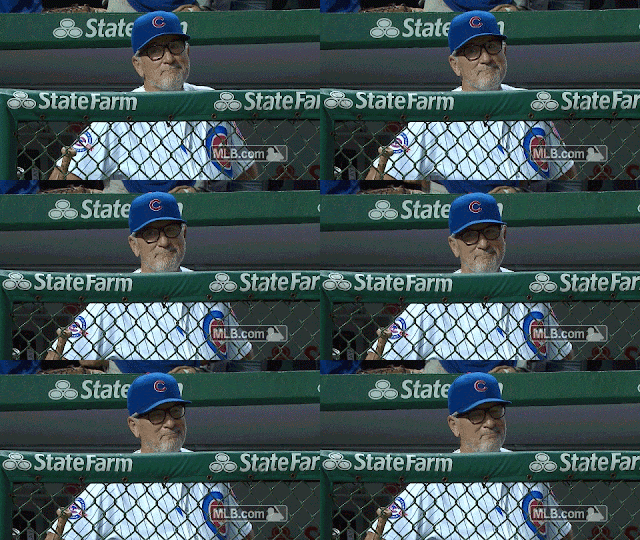
Despite his gaffes and the increasingly frantic complaints from White Sox fans losing their minds that their championship-caliber team is in the hands of this doddering dill weed, La Russa seems in no danger of losing his job because of his close friendship with Jerry Reinsdorf.  That was not the case for another one of baseball's elderly personalities Joe Maddon, who was fired by the Angels in the midst of a twelve-game losing streak.*  Maddon, like La Russa, cultivated a quirky genius of baseball affect, but while La Russa comports himself like a dour prosecutor condescendingly explaining why his office is declining to charge a rogue detective unit that has gone on a spree of stealing blizzard machines from a local dairy queen and turning a police van into a mobile ice cream unit despite them being caught on twelve separate videos, Maddon comes across like a professor who boozes with his undergraduates.  Maddon loves to deploy unorthodox five-man infields, set up squeeze plays, and stash relief pitches in the outfield for tactical purposes.  This season, he issued an intentional walk with the bases loaded in a tied game (the Angels won); with the Cubs, he oversaw a nationally-televised game that involved relief pitcher Travis Wood making a tough catch in left field in the ivy and then ended on a walk-off Jon Lester pinch-hit bunt.  Maddon also brought zoo animals to spring training games, drove around in a van that he referred to as a "shaggin' wagon" and tried to break up a Cubs slump by hiring a magician to entertain the team with a variety of tricks.  It's a routine that was self-consciously quirky and goofy and obviously very annoying except that Maddon won a World Series for the Cubs, which I never thought I would see in my lifetime, so actually all of that was adorable even if the way he used his pitchers in Game 7 may have actually taken years off my life.

Maddon and La Russa represent an increasingly rare kind of baseball manager, the obstinate old guy who is determined to do things his way even if it is obviously self-defeating.  There are few bulbous, purple guys straining at the tensile limits of their baseball uniforms making baffling decisions and then kicking a hat in a way that it seems like it may make them immediately die around the game anymore.  Looking around baseball, most managers seem to be anonymous stubble guys in their 40s and 50s, and their jobs seem increasingly encroached upon by front offices as they oversee constantly shifting lineups and entire relief pitching staffs rotated in and out of the roster with a variety of minor league options and injury list shenanigans like they are hockey lines.  Managers seem mainly to be in charge of vibes, even as many of them appear to be bereft of personality.  Like many changes in baseball, it is obviously smarter and more effective to manage teams this way, but less entertaining than having an angry and possibly day-drunk old guy going with his gut and doing the dumbest thing possible and then yelling at reporters that they never played the game.  Here is a video of Earl Weaver arguing with an umpire and both of them have bizarre Old Man Voices that clearly don't exist anymore to the point that they seem dubbed in by improv comedians.

One disappointing change to baseball in 2022 is that umpires are now talking to us and have boring, normal Ref Voices whereas before the only time we ever heard an umpire speak is when they decided that instead of words they should be bellowing inexplicable throat noises like HRAAAAAAT and DEEEEEKE and we could imagine they all spoke exclusively in a mysterious, runic Ump Language 

I am not sure what the solution is for baseball's crisis in pain in the ass old guy managers.  The game certainly does not need any more Tonys La Russa.  Perhaps we can find a compromise and train the current crop of managers in the art of having truly embarassing on-field meltdowns and also have them smoke several packs a day of cigarettes or watch footage of Burgess Meredith so they know how to rasp weirdly when it is time for them to go nutso on an umpire.  Perhaps Major League Baseball may one day give us a different option in its evolution  between Boringly Optimized and Insanely Stupid.

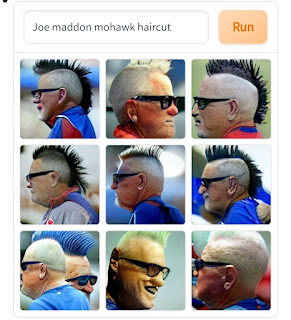
*UPDATE I have just learned that Joe Maddon had just gotten a mohawk haircut in order to rally the troops but was fired before being able to show any of them, presumably leading to a despondent Maddon swilling wine and stewing in his rumpus room while wearing a ridiculous Rally Haircut, this is the most Joe Maddon way to get fired that I can possibly think of. Here is an Advanced AI Rendering:


SOMNAMBULISTS

"...The 'WWI origins' literature has assumed such vast dimensions that no single historian (not even a fantasy figure with an easy command of all the necessary languages) could hope to read it in one lifetime..." writes Christopher Clark in his 2013 WWI origins book The Sleepwalkers. And yet here is his tome, with Clark admitting that he has tossed his work onto the pile while also boldly declaring that he has something fresh to bring to the subject.  Like any historian entering into a crowded, well-trodden field, Clark seeks to refocus the debate-- his overarching argument is that Europe's chaotically unfocused governments combined with some bad contingent decisions allowed the continent to blunder into disaster-- but I think his goal also seems to be writing the definitive recent English-language account of the pre-war years for the twenty-first century that could stand alongside classics like Barbara Tuchman's The Guns of August.  I can't pretend I know enough about the enormous body of literature about the beginnings of the war to say where it stands, but I think that Clark does an admirable job guiding readers through the beguiling international and domestic situations unfolding all over Europe while also having a good eye for the baffling and absurd and often ludicrously-mustachioed personalities who blithely led their countries into an unfathomably horrible conflagration.

One of Clark's contentions is that Serbian politics have traditionally gotten short shrift in grand World War I histories, so he starts there.  He describes the Serbian state as one shaped by regicide and fueled by nationalism and irredentism.  The bloc in power during the 1914 July Crisis had been largely shaped by the party that had assassinated King Alexandar, a child who assumed the throne at the age of twelve after his father abdicated and then four years later performed what Clark describes as a soft coup prematurely putting himself in power in a move orchestrated by his father who then operated as the king all but in name while both father and son alienated Serbians with increasingly authoritarian crackdowns.  Alexandar attracted increased opprobrium when he chose to marry an older woman named Draga Mašin, whom Clark describes as being unpopular because, among other things, she was "well-known for her allegedly numerous sexual liaisons."  

During a heated meeting of the Crown Council, when ministers attempted in vain to dissuade the king from marrying Mašin, the interior minister Djordje Genčić came up with a powerful argument: "sire you cannot marry her. She has been everybody's mistress-- mine included." The minister's reward for his candour was a hard slap across the face-- Genčić would later join the ranks of the regicide conspiracy.

Clark suggests that the murder of Alexandar and Mašin in 1903 brought to power a Serbian government beholden to a radical element that had killed a king and also supported a network of secret organizations that would serve as an unwieldy but influential pressure group within Serbia.  This group would push for increasing Serbian demands on Balkan lands and for hostility against the Austro-Hungarian Empire.

One of Clark's main arguments is that European governments were too disorganized to maintain coherent foreign policies.  Responsibilities, he writes, floated between heads of government, foreign offices, and various ambassadors on the ground, each with their own priorities, connections, and competence.  The other monkey wrench was the presence of monarchs with varying amounts of actual power, effectiveness at wielding it, and ability to communicate to their ministers, the public, and their peer monarchs, many of whom happened to also be cousins with the unfathomably strange family dynamics that come from people who are expected to spend most of their time strutting around in weird military uniforms and bloviating.  These systems led to incoherent policies, communication breakdowns, and swift changes that all created a vortex of chaos swirling over the Continent as the tensions and stakes grew after the assassination of the Archduke.

It is no surprise that the most compelling personality Clark writes about is Kaiser Wilhelm II.  Clark is a historian of Prussia and his previous work includes a biography of Wilhelm, which I am curious to read because his portrayal of the German monarch is one of the nastiest and funniest I have seen in a book like this.  Clark describes Wilhelm as a blundering oaf, a belligerent hawk constantly calling for war only to panic and seek conciliation when it looks like he might actually provoke a real conflict, and as personally extremely annoying. 

"It is worth picturing this scene--" Clark writes about a meeting between the German and Russian governments in 1912, "the glare of the sunlight on the broken stone of the old fort, [Russian prime minister Vladimir] Kokovtsov sweltering in his jacket, the Kaiser red-faced, his moustaches trembling as he warmed to his theme, gesticulating, oblivious to the discomfort of his companions, and behind him the Tsar, trying desperately to end the ordeal and get the party out of the sun."  Earlier in this summit, Clark writes that Wilhelm harangued the Russian foreign minister Sergei Sazonov "for over an hour in detail about his relationship with his parents, who, he claimed, had never loved him."  

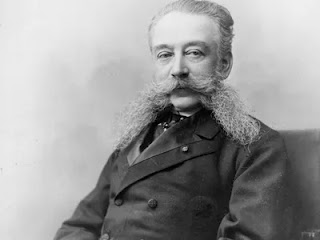
Even his mustache seems to be saying "enough with this guy"

This is the point of the review where a normal person would discuss how Clark sets up the interplay of increasingly dangerous European power dynamics that could explode into a widespread war (the Austrians, for example, had considered the possibility of what they called a "Balkan inception" long before the assassination of Franz Ferdinand and even longer before the phrase could be used to describe an ill-considered bootleg DVD purchase) with bad and almost blasé decisions by European statesman.  But you are reading a book review on a blogspot post that is largely an angry jeremiad against Tony La Russa, so it's important to point out the quantity of World War I Guys who spring out of these pages as tossed off asides or in photos.  Clark casually mentions that the head of the British mission to the Ottoman Navy was a person with the arresting name Arthur Limpus.  Almost everyone pictured has alarming and terrifying facial hair that I can imagine the tension in the room not only from high-powered negotiations but also the ever-present danger of ministers or adjutants or other minor dignitaries somehow turning their faces in the exact dangerous angle that results in a tangle of dangling mustaches, whiskers, and styles that can only be described as side-beards as white-gloved waiters sprint for scissors and dashing junior military aids draw their sabers, much like how the alliance system led to powers like Britain, Russia, Germany, and sometimes Italy getting sucked into a dispute between Austria and Serbia. 

It is impossible to imagine Russian Prime Minister Ivan Goremykin making it through an entire day without getting his mustachios stuck in some sort of gears or dumbwaiter 

It has become fashionable for historians to relate their work to the present context instead of leaving it to succeeding historians to take a look at what was going on when the book was written and decide that their work on Ottoman tapestries is reflecting Contemporary Cold War Tensions or something.  In this case, Clark is concerned about the breakdown of the international order in Europe during the European sovereign debt crisis unfolding in the early 2010s as the book was coming together.  Reading this less than a decade later, this view seems quaint.  Unfortunately, I think readers in 2022 need little convincing about the fragility of peace in Europe, and while Clark, writing in 2013, claims that foreign relations are more streamlined and less convoluted than they were in 1914, I think he would agree that world leaders don't have the decency to parade around with elaborate and impossibly stupid mustaches anymore.  

Monday, May 9, 2022

An Aesthetic Review of Baseball in 2022

Major League Baseball gets stereotyped as a slow, hidebound organization bound up in its own tradition and high on its own bow tie colunmist-addled romance, but the signature element of Rob Manfred’s tenure as commissioner has been rapid change in rules, strategy, and the general aesthetics of the game.  Within the last decade or so, MLB has imposed new limits on a game whose signature feature is a lack of a clock and the basic idea that the game lasts for 27 outs.  Now, teams have restrictions on when they can bring in relief pitchers, which has not done anything to stem the game from shifting to an endless parade of relief pitchers, and it has put a finite cap on mound visits, which has only existed to confuse people who are wondering what MVR means on a scoreboard.

The biggest and most noticeable change to Major League baseball in 2022 has been the long-predicted move to bring the designated hitter to the National League.  This is a recapitulation; the DH appeared in the NL during the odd, shortened Covid Season and then last year baseball fans were again treated to the absolute shittiest hitters to play in Major League games ineffectively flailing at baseballs and almost always getting out.  I assume that anyone reading this has attempted to discuss the designated hitter and is aware of the poisonous futility of the debate where fans of pitchers hitting discuss strategy and symmetry and the pro-DH faction attacks its opponents as sepia-toned bowties; in the worst case scenario, an American League pitcher would get injured running the bases and we’d have a debate over whether the professional athletes that do so much damage to their arms that a Frankensteinian cadaver ligament procedure is now considered routine should be shielded from the extremely dangerous task of running briefly in a straight line.  

I am not interested in discussing strategy or ASSETS or anything that has to do with the effects of designated hitting on actual baseball.  Instead, I am approaching this by weighing the aesthetics of the extremely common and hideous results of pitchers hitting (almost always getting out, horrid strikeouts, the contemptibly cowardly strategy of managers walking the eight hitter to get to the pitcher, sacrifice bunting) with the much more rare and sublime sights (an opposing pitcher fuming after giving up a hit or walking his counterpart, the ecstasy of a pitcher home run, pitchers wackily pressed into outfield duty).  In essence, I am weighing how many mind-numbing and unwatchable pitcher plate appearances are worth it for the sight of a guy standing somewhat confused on first base wearing a dorky satin jacket.  The other important element to weigh aesthetically is the actual designated hitter, whether watching an enormous, beefy oaf get to blissfully bop dingers versus watching him lummox around on the field.

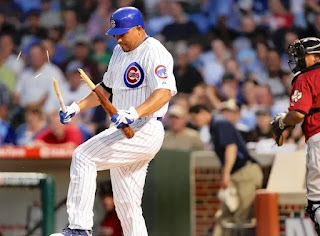
An aesthetcially perfect baseball image. In 2022, Zambrano as a pitcher would have no understanding of how to use a bat and he would be at a complete loss as to how to destroy a Gatorade machine

Unfortunately, we had a perfect solution for this by having both sets of rules operable at the same time, but even with the advent of the universal DH, we are getting aesthetically shortchanged.  The universal DH has not led to the addition of several pleasingly refrigerator shaped doofuses showing up to destroy baseballs, but with a lot of teams choosing to rotate their designated hitter among the otherwise normal roster.  Kyle Schwarber, a man who is built like he hangs around the wharf antagonizing Popeye, one of the most prototypically DH-shaped human beings currently produced by baseball, has constantly found himself forced to ply his lummoxical arts in the outfield, first by the Cubs in 2020 when they elected to use a backup catcher as the designated hitter, and now by a Phillies lineup that is so graceless and lead-gloved that he is their best option in left because the operating philosophy in Philadelphia was to build a team of sixteen-inch softball players.  In my mind it is not only an aesthetic downgrade to replace the 25 times a year when a pitcher does something cool on offense with a DH rotating among fourth outfielders and backup catchers; it is a catastrophe.

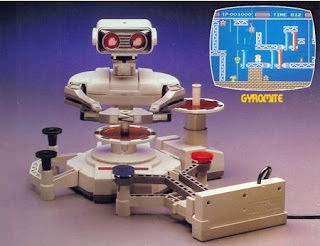
The other major innovation is the PitchComm system where catchers wear a small device that looks like an NES controller that relays a pitch type and location to a small speaker located in the pitcher's hat.  This is designed to obviate the use of hand signals and prevent them from being stolen by other teams while also speeding up the game so that the pitcher does not spend what seems to be 38 minutes squinting at the catcher in between each pitch.  This is a triumph.  Even though dugouts are now filled with tablet computers and scoreboards show HD highlights, this is first on-field innovation baseball has had that makes the sport seem like it is evolving into High Tech Future Baseball since outfielders discovered those elaborate futuristic sunglasses in the 1980s.  

PitchComm seems to be simple, works, and looks really cool strapped to a catcher's arm or shinpad.  For several days, I desperately wanted to hear what the PitchComm voice sounds like, and when they played it on a Cubs broadcast, I was disappointed although not surprised that it is the same generic computer voice that tells you that your call is important to Comcast that is also telling a genetic arm freak to throw a 98 mph heater on the outside corner.  

(UPDATE May 25: a recent Cubs broadcast has informed me that teams are free to choose their own voices for PitchComm.  The Phillies, for example, use the voice of catcher J.T. Realmuto.  The ideal voice for the Cubs is unfortunately the late actor Dennis Farina screaming at the pitcher to "throw da fuckin' cutter," but I have heard the Cubs are experimenting with the voices of Svengoolie and Peter Francis Geraci who implores pitchers to consult his breaking ball info tapes.    

I think that it should be possible for catchers, in emergency panic situations, to switch the voice to Arnold Mode.  I also remain intrigued with the possibilities for a team to hack into the oppositions PitchComm system or for teams to elude to it the same way that Ryan Tepera insinuated that the Houston Astros were at it again in last year's playoffs after a vanquished team notices that the Astros' new coach in the dugout is a code-breaking robot hidden under a trenchcoat.

The Houston Astros introduce their new Quality Control C.O.A.C.H.

THE NFL DRAFT IS THE QUINTESSENTIAL AMERICAN SPORTS EVENT

The NFL Draft has come and gone again, the single most deranged event on the sports calendar and the most quintessentially American, replacing any game action with a large crowd of people who cannot possibly have an informed opinion on anything going on and yet are getting insanely mad.  I love writing about the NFL draft because of its disparate and genuinely alarming combinations of freaks: the NFL executives who put on this bloated and cartoonish paean to the self-importance of the National Football League led by a commissioner losing his annual duel with a teleprompter; the facepaint maniacs enduring hours of tedium in order to hoot and holler for players they have never heard of in order to be shown hooting on television at the opportune moment; Mel Kiper, Jr., one of the genuinely weirdest sports-adjacent personalities on the face of the Earth whose appearance on a satellite feed combined with his ascending balding Dracula haircut made him seem like an evil Space Emperor cutting into the broadcast to threaten the planet with an offensive lineman who should have gone in the second round; and (most disgustingly) dorks watching the draft for content to put on their sports blog for three dozen people.

Kiper demands the people of Earth send him a "sudden, explosive" pass rusher or he will laser Jimmy Clausen's face onto Mount Rushmore

Yet while the NFL Draft serves as an insane fever dream, the league has actually managed to ramp up and hype the draft to the extent they have successfully made it a traveling annual party for fans of the league.  This is in addition to the Super Bowl, which is already an annual party involving the NFL, albeit one that seems to be catered increasingly towards corporate sponsors and not a place where a person who has worked very hard on an elaborate Arizona Cardinals bird headpiece can get on television bellowing about a 6th round guard from Gerald University II.  The NBA's all-star weekend functions like this as well, as a sort of party and NBA convention.  Major League baseball throws its annual party when an 85 year-old person from Boston writes a 250,000 word book about the pastoral grace and youthful violence that provided the keening engine for America and then immediately dies.

This year, the NFL managed to lessen its own berserk weirdness by putting the draft in Las Vegas.  The magic of the draft presentation combined the draft's procedural inanity with the NFL's version of spectacle, which gave it the air of an alien circus.  There is simply no way to describe NFL draft decisions like "Mike Mayock threatens to walk off the set after an orangutan reveals draft picks using an ipad" that does not seem like it is lifted from the Paul Verhoeven Starship Troopers.  Unfortunately, Las Vegas runs entirely on knowing, campy excess, so there was no amount of cheesy Criss Angel tricks or appearances by an orange, plasticine Wayne Newton that did not feel out of place.  The most interesting thing that happened on the parts of the draft broadcast that I saw was former Viking Ed Marinaro rambling for so long that an NFL official came out to scold him, very nearly brandishing a vaudeville hook.

The move to Las Vegas allowed the NFL to do the unthinkable and outsource its draft spectacle to local entertainment instead of trying to manufacture it.  There is something ineffable and intriguing about the way the league presents itself in all aspects other than the game itself, with a perspective that seems rooted in a remote executive clubbiness that is completely divorced from a multi-billion-dollar entertainment concern.  At all times, the principle guiding the NFL is a mix between stodginess and the things that genuine country club weirdos like Goodell or maybe Jim Nantz think would be interesting.  More than any other league, the guiding hand of the owners' bizarre sensibilities pokes through the entertainment side of the NFL leading to one of the strangest things annually to appear on mainstream television.  

The draft broadcast should feel like an eerie dystopian nightmare bracketed by truck commercials but failed in that respect this year.  This is why I propose that the next NFL draft should be held on an aircraft carrier.

Thursday, March 24, 2022

An Incompleat Taxonomy of March Madess Characters

Every single year I watch less and less college basketball and know fewer and fewer players on any of the teams and think I could not possibly care about the NCAA Tournament and then I watch a few minutes of a game and get hopelessly sucked in because a team I’ve never heard of whose mascot is a disconcertingly accurate marmot or cartoon rendering of a blacksmith whose plush face has features a horrifying rictus has an ungainly 6’9” center with a wispy mustache wearing what appear to be prescription shoes who is somehow getting buckets off an NBA lottery pick and I am back in. 

A delightful air of mystery surrounds the tournament. The sport is simply too large and unwieldy for anyone to master, and with one and dones and players transferring it is hard to keep track of who is even on the big teams anymore to the point where the eight foot person on Purdue has a different name every year. The tournament thrives from its veil of ignorance; there are entire schools no one has heard of and players no one knows that arrive fully formed at the tournament with their whole thing that they have spent the last five months workshopping in dusty conferences at the margins of their sport until they are on the court desperately trying to beat a name brand school before blowing three consecutive attempts to inbound a ball.

The NCAA Tournament is where the weaknesses of college basketball as a product– that it is generally very bad basketball when compared to the professional leagues– work exactly in its favor because no one cares what the games look like or how they are played as long as they are close and there are upsets. Teams, even those with future NBA stars, melt down. They miss shots. They commit atrocious fouls. There are probably cumulative hours of NCAA tournament play each year where someone who is months away from starting dental school is ineptly throwing James Harden step-back threes in the general direction of the rim and instead of being aesthetically revolting it is exciting because the opposing team has a 5’9” point guard who is wearing what appears to be a giveaway t-shirt underneath his jersey and refuses to miss. I understand the NBA people who, even putting aside the monstrous elements of college sports, hate college basketball on an aesthetic level, but in the tournament it is precisely the maddening and inexpert play that allows strange teams filled with unorthodox zones or unexpectedly lumpy players to rub elbows with the glamor teams and makes everything so entertaining.

The ephemeral and unexpected nature of the NCAA Tournament means that we will see players appear that we have never heard of and become legends for several hours or maybe a week or two before fading back to obscurity. The top of the line March Madness guy is a large, unexpectedly doughy oaf who is the best player on the team, somehow throwing dazzling passes out of the post or throwing up preposterous layups and hook shots. The second best is a very short player who catches fire from three. The next best is a freaskishly tall player; there’s at least one in every tournament, and since the NBA has stylistically negated gigantic, earthbound centers, it’s always nice to see a reminder that being enormously tall is an advantage in basketball as this guy lopes around and drops the ball into the basket or swats opposing shots into the stratosphere while only sort-of jumping. It is also very important for a successful NCAA tournament to have players who favor atrocious semi-formed facial hair, unnecessary accessories, or unorthodox hair styles destroy a big-time basketball program while the opposing coach writhes in agony.

While novelty powers the NCAA Tournament Experience, there is also a comfort in familiarity. Though college basketball’s overwhelming discourse revolves around movement-- top players leaving for the NBA after a year and the constant churn of transfers-- any moment of continuity helps, so a lesser type of enjoyable NCAA tournament character are players on perennial tournament teams that come back year after year until they appear as the most wizened and grizzled 24 year-olds on the planet. There are also the coaches who appear every year with the same rat-based yell faces, the same hoarse screams, the same cronenbergian combovers straining over undulating head veins. Generally if you recognize a college basketball coach, there is no joy greater than seeing him tossed from the tournament like rotting produce.

The reassuring sight of Brad Underwood's combover that looks like a 
tarantula that is grasping onto a half pound of ground chuck

There’s a sports radio cliche that everyone roots for upsets the first week and then wants to see the big programs after that, but that is not true for me. I want to see the upsets in the first rounds and then not much else because the schools I’ve never heard of coming out of nowhere and the various unexpected basketball weirdos they produce forms the only necessary part of the tournament. The whole event’s appeal for me is that it is a few days of chaotically delightful sports nonsense that happen on a weekday while you are probably supposed to be doing something else. After that, it’s just college basketball.

THE CUBS INTRODUCE THE ARTFUL MONEY-TANK

The MLB owners ended their lockout only after the rounds of fruitless late-night negotiations, the secret last-minute provisions, the endless shots of baseball players in casual conference-ware walking determinedly across parking lots, and the universal derision aimed towards commissioner Rob Manfred for being Rob Manfred. After the bitter labor fight, Manfred and the league decided to placate angry fans with the only gesture that can delight twenty-first century sports consumers: a relentless flurry of Big Time Deals. Within several days, teams began a whirlwind of signings, trades, and player movement that have come to overshadow sports themselves and by now have their own rituals: the Auspicious Reporter Tweet, the Eyeballs Emoji, the Dribbling of Incomplete Information, the Let’s Go Bicep Emoji Tweet, and finally the Jersey Over Dress Shirt Press Conference. I’m not going to pretend I’m above this as I monitor the rumors and hoot and holler with everyone else because for some reason sports transactions hit an incredibly satisfying part of the brain even if the hit is brief and ephemeral and it is clear that the Cubs are going to continue to stink.

At the very last second before the lockout, the Cubs locked up pitcher Marcus Stroman to add to their beknighted rotation. Then they emerged from seemingly nowhere to sign the star Japanese outfielder Seiya Suzuki. Suzuki, one of the top hitters in NPB for the Hiroshima Carp, inexplicably eschewed a number of contending teams to sign with the Cubs. He is the best possible kind of signing for this Cubs team because he arrives as a mystery who can exist as pure possibility. There are no MLB stats to quibble with that always come with worrying indicators that any success is bound to regress to the mean and no emotional baggage from being annoyed with him on the other teams; Suzuki currently exists only as insane NPB stats and videos of him hitting exquisite bombs and the hope that somehow he could become a superstar to replace the World Series heroes that the team so cynically jettisoned at last year’s trade deadline.

The big splashy moves that the Cubs made don’t make any sense because if the Cubs wanted popular, expensive, and skilled players they could have simply re-signed even one of their World Series stars. Instead, the Cubs appeared to be poised to rebuild, to gleefully throw themselves into the shitter and hope that a few of the teenagers they traded for will be good in several years while charging major league prices to watch some minor league flotsam. Other than those two signings and a few cromulent major league veterans to completely avoid embarrassing themselves, this is what they are doing. Unless it turns out that the 30 year old guys who unexpectedly had a few hot months are actually somehow good now, that Frank Schwindel is somehow the second coming of Miguel Cabrera, and that all of their underperforming holdovers all of a sudden start playing the best baseball of their lives, the Cubs will be a very bad baseball team. But if the Cubs are tanking, at least they put a little bit of art into it, throwing us a couple of bones with Stroman and Suzuki while watch Baez in Detroit, Rizzo in New York, and Bryant in some sort of phantom zone. Until those jerks trade Willson Contreras.

A TOAST

Matt Berry has the gift of a sonorous baritone voice that he wields expertly to make himself sound like a spectacular dipshit. I first became aware of him watching grainy downloaded bootlegs of Garth Marenghi’s Dark Place, a British show about a schlocky horror novelist whose 1980s supernatural hospital drama has been resurrected and intercut with interviews with Marenghi and the cast and featuring deliberately awful acting, clumsy effects, and atrocious dialogue. Berry played Dr. Lucien Sanchez, the sidekick for Marenghi’s character Rick Dagless M.D., whose job is to gravely ask questions and fight supernatural forces with karate.

Berry also had a wonderfully strange sketch show called Snuff Box and is great on the vampire comedy What We Do In The Shadows, but my favorite thing he has done is the bizarre theater comedy Toast of London. He plays boorish actor Stephen Toast, who desperately attempts to work in a surreal London thespian world of deranged plays often opposite his sworn nemesis Ray “Bloody” Purchase, nonsensical voice-over roles helmed by sneering producers one of whom is named “Clem Fandango,” the concept of “high winds acting,” and various directors all played the same guy who at inevitably threaten to murder him. But Toast of London is not really about anything more than an excuse for Berry to pronounce words in a ridiculous way and for people to have silly names. It is the type of show where a joke is that Purchase greets Toast by saying “well well well” to him with the camera dramatically zooming in on every “well.” 

It is rare that a camera move gag lands so well, but one of my favorites in recent years comes from the master of the camera zoom joke Hong Sang-Soo.  The quick pan and zoom to the woman in the car looking miserable after her friend angrily calls her stingy and storms off tearily during the road trip in the movie Night and Day is funny even without the context of the pathetic quasi-love triangle. 

Seven years after the last episode of Toast of London, Toast has returned in Toast of Tinseltown, where Stephen Toast has come to Los Angeles in the belief that he has a role in a Star Wars film. The Hollywood setting gives him a new tableau of strange characters– the first thing you see is in Toast of Tinseltown is Larry David playing a JFK conspiracy theorist who is teaming up with Clem Fandango to berate Toast who is incredulously narrating his audiobook. But Toast of Tinseltown does not go Hollywood. The show was filmed in London and (with some exceptions, including a mysterious and annoying roommate played by Fred Armisen and his housekeeper who is not all she appears to be played by Rashida Jones) largely features British actors doing variously successful American accents. This creates an even more surreal Hollywood artificially created on British sound stages that feels of a piece with the earlier incarnation’s grotesque London.  Hollywood is so fetid and filled with weirdos that even with Toast's baseline befuddlement and malevolence, he is occasionally the voice of reason.

The change of scenery has thrown Toast of Tinseltown off a little bit, unmooring Toast from his usual haunts for the most part and adding in awkward Zoom cameos, but the basic Toast rhythm of him finding himself in a terrible acting job filled with deranged people with ridiculous names and then making it worse by being an unaware, malicious (Berry would probably pronounce this mal ISS eee us) buffoon, and that is exactly what I needed.  There is a hospital drama where Toast is paired with an international pop star who breaks into an unexpectedly bawdy rap, there is an almost hallucinatory trip to the desert, there is a dream-like meeting with a Hollywood legend in black and white, there is (of course) Clem Fandango adapting to a California lifestyle seemingly engineered to irritate Toast.  

Toast of Tinseltown came out early this year in Britain.  I have no idea when or if it will be available to watch legally here.  I managed to track down a low-quality bootleg version because I could not wait, just like how I had watched the original series on a youtube feed where the entire thing had been shrunk to a small corner of the screen to avoid detection.  Though it's not ideal, there's a certain charm to watching it this way, almost reminiscent of the effort it took to track down weird cult stuff before the internet trained us to expect everything to be easily available instantly and all of the time.  Hopefully, it will be available soon on one of the streaming platforms so I can see what happens when on the version I saw the video cut out and just showed a blurry, red Toast head superimposed over the screen, but perhaps that is the way it is meant to be seen.

Wednesday, March 2, 2022

Bulls Fans Have Been Waiting Nearly 25 Years For A Guy To Do Turnaround Jumpers Again

Every time DeMar DeRozan goes to the line in the United Center, he is  serenaded with MVP chants.  Certain NBA numbers-mongers would say that he has virtually no chance of winning, towered over by several big men who are all having better seasons.  But DeRozan, who has been brilliantly carrying a Bulls team hobbled not only by the franchises's traditional suite of knee injuries but also missing two players who broke their wrists after getting clotheslined at the rim, has cemented himself as a Chicago sports legend by getting as close to replicating Michael Jordan's offensive game as humanly possible at the exact moment that the city has been thrown into a Jordan-crazed reverie by a ten hour documentary where ESPN let him swill tequila and say fuck at his myriad basketball enemies when they are shown to him on an iPad.

The threes-and-layups architecture has taken over the NBA and I can't complain too much; the style of play and the rules changes that make it illegal to bludgeon players with their own ripped-off arms has generally made for a more entertaining product than the hideous trench basketball of the Jordan heyday.  But it is still nice to a player absolutely punish an opposing team with the fadeaway jumpshot, a technique that DeRozan has been stubbornly clinging to as the master of a forgotten art.

For me, the midrange turnaround jumper was The Shot.  It was how Jordan amassed his points, by posting up an opponent sixteen feet from the basket and shooting over him over and over and then barraging him with a variety of unhinged insults.  Every once in awhile, a player would emerge as a Jordan Stopper or, even worse, a Self-Proclaimed Jordan Stopper, and more often than not, he would find himself on the losing end and then have to listen to Jordan derisively laugh at him while wearing the largest suit ever created for a 6' 6" person. 


It was not Gerald Wilkins's fault that the media labeled him the "Jordan Stopper" but I can't imagine a worse fate for an otherwise anodyne 1990s NBA player than becoming a Named Jordan Adversary

The Shot became the calling card for so many star NBA scorers as a proving ground.  I used to gauge whether a college wing could get off The Shot as a good barometer of whether they could get off enough space to be able to score in the NBA, even though I have no idea what I'm talking about but it seemed like a good sports opinion to lay on someone unfortunate enough to be drinking beer near me during an NCAA tournament game before they were forced to detonate a smoke bomb and vanish to a stool next to a less annoying person. 

I believe that there are two reasons that the midrange turnaround jumper became less prominent.  One was the rise of basketball analysis on the internet which included actual spreadsheet perverts demonstrating how inefficient the shot is and then a bunch of people who half-understood it but wanted to sound smart also parroting this line by admonishing midrange shooting without nuance and also constantly shoehorning in inescapable references to Game of Thrones, a television show I have never seen but could probably credibly explain the entire plot of because I wanted to read about whether Jimmy Butler was getting All Star Momentum in 2013.  The other reason is that, let's face it, the turnaround jump shot in the hands of anyone short of an actual master can be a hideous abomination, and there were years in the early 2000s of Headband Guys fruitlessly bricking isolation eighteen-footers at each other for minutes at a time while getting sourly scolded by Hubie Brown.

The Bulls have had several very good players since Jordan, but DeRozan is their first star player who has managed to ascend to the aesthetic of his game.  He is doing this with a hail of fadeaway jumpers, and in the fourth quarter he is throwing them in like the basket is magnetized.  At the end of a game, teams are sending two or three guys directly at him and he is still cruising to his spot just off the free throw line where everyone in the building knows he is going to, throwing up three or four pump fakes (this is a unique DeRozan signature), and baiting an opponent into bumping into him while he hits another shot.  It does not matter.  He doesn't miss.  He is on a scoring streak matched in a Bulls uniform only by Michael Jordan.


The Bulls didn't need a reasonable Jordan facsimile to be fun again.  They needed good players and for the front office to be made up of normal people and not weird head guys constantly accused of doing John Le Carré-style espionage.  Bulls fans would be delighted with DeRozan having his marvelous season with a more modern array of moves.  But for middle-aged Bulls fans, seeing a player dragging the Bulls back to relevance whose game is a Proustian sense memory of the team's annual humiliation of Patrick Riley is an added delight.

THESE MOTHERFUCKERS LOVE CANCELING BASEBALL GAMES

It's been clear for the past few years that there was not going to be a full Major League season in 2022 as the owners became increasingly brazen in their anti-baseball agenda and the players signaled their growing disgust with barren free agency periods and multiple franchises refusing to field competitive teams.  But the way it ended, with a smirking Manfred making the Animal House oh boy is this great face at reporters while gleefully wiping out the first week of the season, made for a grim coda to the week of parody negotiations by owners who came down to Florida specifically for the purpose of canceling games.

Rob Manfred's job is to go out in front of reporters and tell them how the players' recalcitrance is preventing games from being played even though the lockout is a unilateral imposition from league ownership that they could lift at any time.  Manfred is not even a fun villain.  He exudes the tedious menace of a middle manager.  Somehow he is boring and humorless enough to submarine whatever point he is making without ever ascending to the stiff dignity of a person it would be funny to see Rodney Dangerfield shove in a pool.  And yet, Manfred needs to be out there because the alternative is for baseball to put one of the owners, a conglomerate of blotchy oligarchs who consist exclusively of financial criminals and sons, out there to weep about how paying the Collective Bargaining Tax would leave them destitute or by gnawing on something.  The only owner who seems to have any sort of public personality is a slimy hedge fund guy implicated in insider trading who openly feuds with his team's players on twitter for Doing Thumbs.  

All sports commissioners share the important job of having fans call them a piece of shit while the team owners berate the staff of their yachts but the disconcerting thing about Manfred is that he seems to enjoy it.  Unlike Roger Goodell, who carries himself like an embattled governor and loves to do Investigations and talk about Resiliency In These Uncertain Times or Adam Silver whose role seems to be to try to keep team owners from publicly clashing with the NBA's celebrity superstars egregiously enough to affect the league's profits, Manfred seems to exist completely outside the sport.  He seems like he'd be delighted to lock out workers in any industry.  While Goodell imbues the NFL with a ridiculous air of importance as an American institution on par with a government department and Silver sees the NBA as a lucrative television product to sell around the world, Manfred's relationship to baseball seems completely abstract.  He is a dour henchman.

Every time you see this Manfred guy on television it is because he spends 90 percent of his time sourly shitting on baseball or introducing some asinine new rule to fix the game by shaving fifteen seconds off a mound visit.  He says this while his bosses put their games exclusively on regional cable networks that are involved in intricate carriage rights disputes that mean that no one can even watch the games and while they call for increasing the number of playoff teams to an amount that is beyond the number of teams actually trying to field a competitive team.  Maybe baseball is so slow and long that it has always been destined to become a relic of a sport like horse racing, boxing, or even bowling but it sure would be interesting to find out what would happen if it was not controlled by group of people who treat the players, fans, and the sport itself with such contempt.

THE WINTER OLYMPICS SHOULD BE MORE FLAT

The Olympics may be a cesspool of scandal from grasping middlemen but there is one outrage that no one else has the courage to expose and that is that the so-called "Winter Games" disproportionately take place on mountains.  I have done the rigorous research of looking up the 2022 Winter Olympics on Wikipedia ("Bing Dwen Dwen's astronaut-like clothes imply that the Winter Olympics embraces new technologies and create possibilities") and more than half of the events required athletes to fling themselves down mountains or on ramps located on mountains.  This is a preposterous situation.  The Winter Olympics should add more flat events.

As a Midwesterner, I resent the association of winter with bluff people in neoprene suits and goggles jauntily flying down mountains.  Many of us experience winter as an endlessly bleak grayness  where the beauty of fallen snow is almost instantaneously rendered into beige sludge accented by dog piss and where the only thing we can rakishly throw ourselves down is maybe a pile of garbage that someone made into a small hill in a park.  Imagine if more than half of the Summer Olympic events involved athletes barreling down a hill in a soapbox derby car or hurling themselves off of a cliff in one of those extreme sports squirrel suits.  These are not the Mountain Olympics.  I am absolutely not a crank to demand that the IOC think about people who live thousands of miles from the nearest elevated surface and spend months standing on train platforms where slush hits them in the face horizontally while they huddle under one of those ineffectual heaters when they are determining which games to label as "winter."

Sure, the flat regions have ice skating, hockey, curling, cross-country skiing, and cross-country skiing while shooting a gun.  That's enough for you, is what the IOC says while handing the rest of the events off to a bunch of Alpine maniacs who recreate by trying to smash their heads into an ice wall while finishing a course three tenths of a second faster than their opponent with whom they have an inscrutable feud over who gets to be the Bad Boy of Bobsledding.  But I refuse to accept these scraps.  It's time for people form lowlands, flatlands, and basins to come together and demand Competitive Snow Shoveling.

Anyone who has ever lived in any sort snow-prone area has spent a depressingly large part of their life shoveling snow off driveways, sidewalks, and around cars that, when moved, people invariably throw a bunch of old chairs, buckets, tomato cages, religious figurines, etc. in to save their spot in a ritual that every cold city in this country claims is some sort of charming regional practice even though it is an inventible consequence of snow and street parking.  Who would not tune into the Olympics to see which country produces the persons who can claim they are the greatest at shoveling?

Competitive shoveling would work by giving athletes a uniform volume of identical snow to clear in a timed event.  People can compete by themselves, in pairs, and in semi-pairs where only one athlete is shoveling and the other person is yelling at them.  For the first several years, we would be witness the beginnings of the sport where shoveling athletes had not yet figured out the optimal techniques, equipment, and body shape for competitors so the first few years would be the shoveling equivalent of those Van Damme fighting tournaments where a karate guy is fighting either a sumo wrestler or a boxer or a guy who is channeling the fighting spirit of a lemur and rolling around in disconcerting ways.  Sports fans the world over deserve to hear an announcer grimly noting that a shoveler caught up on some ice caused by a tire tread is not going to want to lose valuable tenths of a second there or finding out that the greatest snow shoveler on the planet is a grumpy 54 year-old Estonian or a prodigy from a tropical climate.

It's time to end the domination of the Winter Olympics by dashing snowboarders and lunatic ski jumpers and give people who spend their time trudging through giant piles of snow while saying "dammit" under their breath more space in the Olympic Games by timing how well they can shovel several cubic feet of snow for my entertainment.